TRAFFIC LIGHTS
 | «With vertical positioning of signals» |
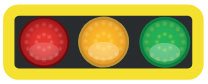 | «With horizontal positioning of signals» |
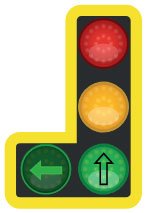 | «With an additional section» |
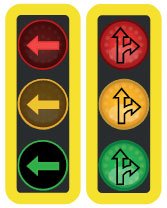 | «To regulate movement in certain directions» |
 | «Reversible» |
 | «To regulate traffic through railway crossings» |
 | «To mark unregulated intersections and pedestrian crossings» |
 | «To inform that a forbidding red signal is turned on for vehicles in the opposite direction» |
 | «To regulate the movement of trams and other route vehicles» |
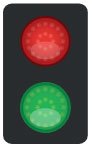 | «To regulate traffic on the territories of enterprises and organizations and in places of narrowing of the roadway» |
PEDESTRIAN TRAFFIC LIGHTS
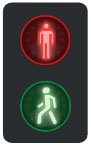 | «Pedestrian traffic lights» |
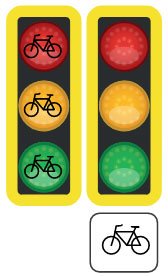 | «Traffic lights to regulate the movement of cyclists» |
TRAFFIC CONTROLLER HAND SIGNALS IN PICTURES WITH EXPLANATIONS
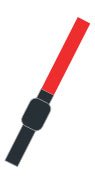 | «Ttraffic control baton» |
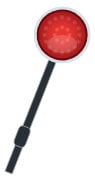 | «Disc with a red reflective surface» |


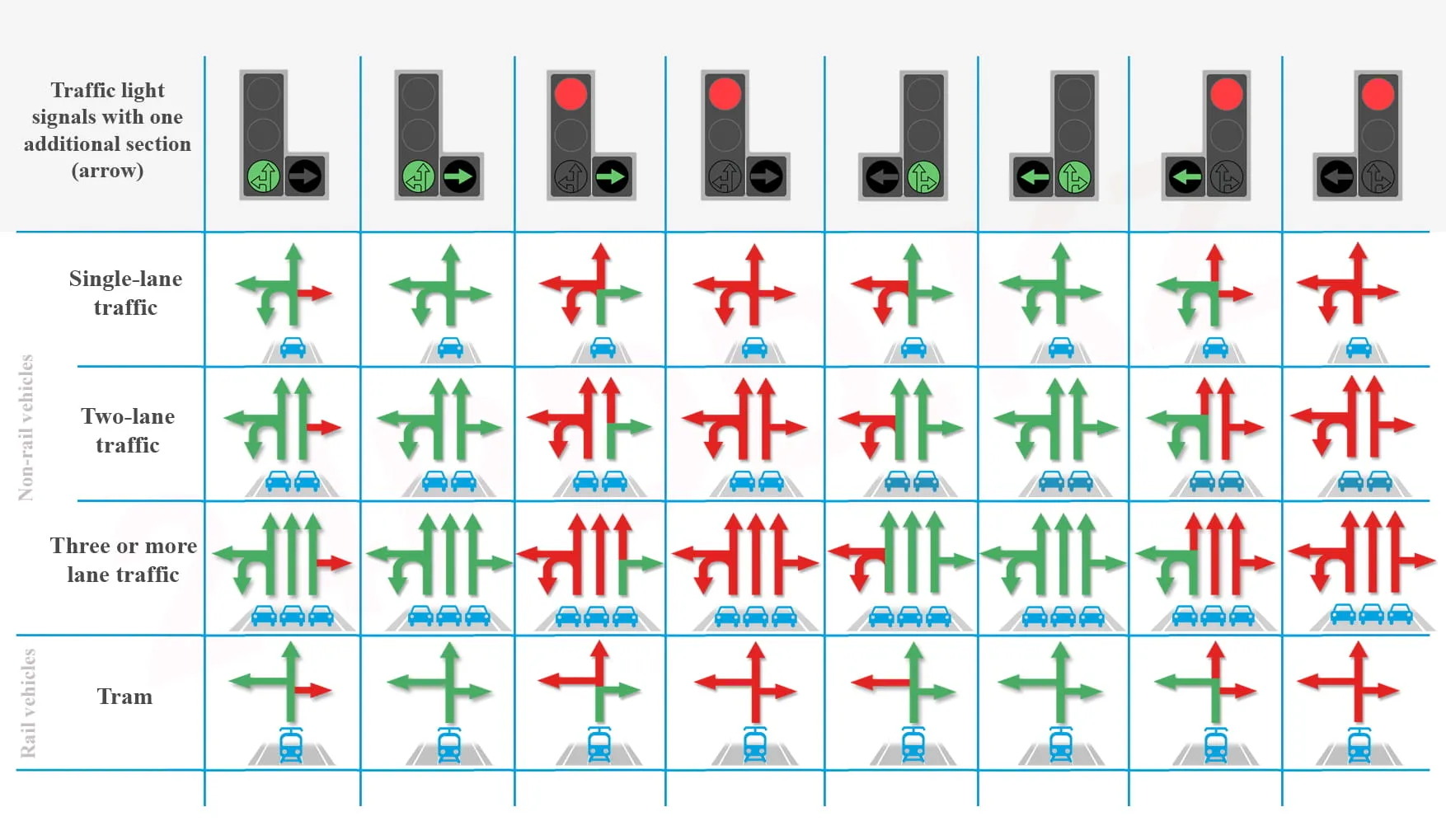
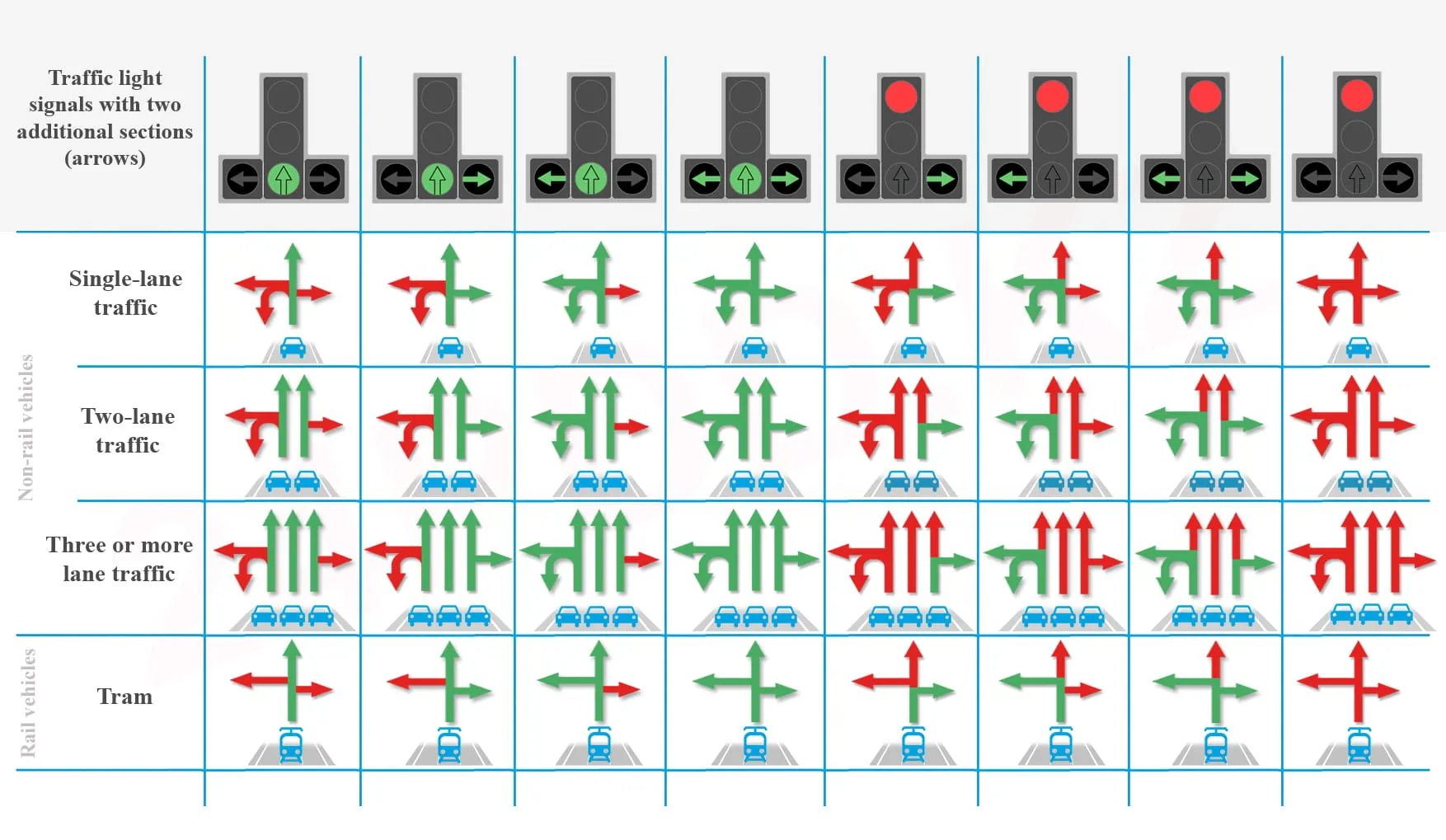
Traffic light with additional sections:
An additional section of a traffic light is placed to the right or left of the main signal, or on both sides, and shows only a green arrow signal. Sometimes it is equipped with a red ring so that drivers can see the section itself in the dark when the arrow is not illuminated.
1) Permitted directions of movement with various traffic light signals with one additional section (arrow):
 2) Permitted directions of movement with various traffic light signals with two additional sections (arrows):
«Reversible» traffic light:
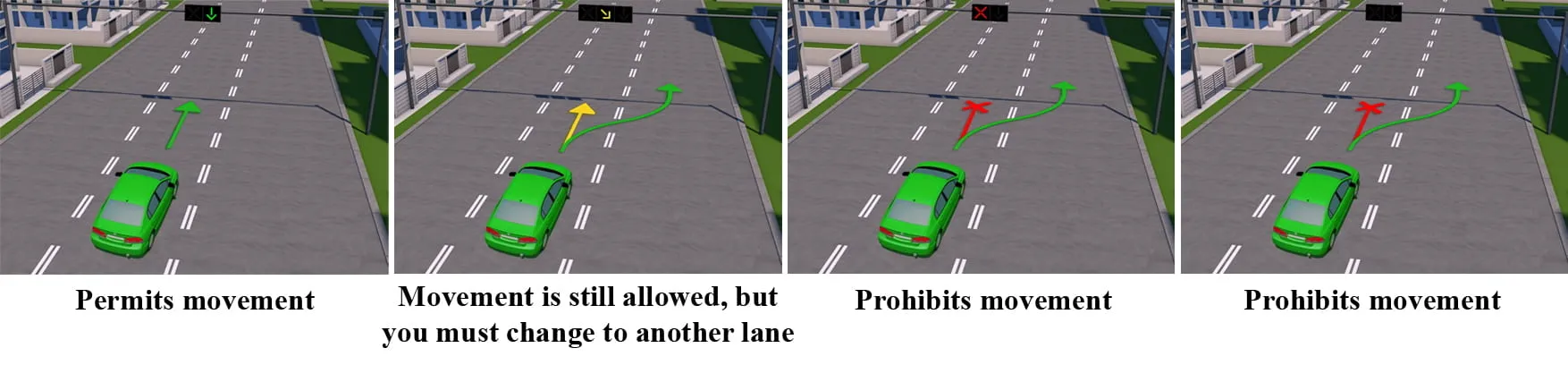
Used on reversible lanes, where the direction of traffic in a lane can be changed depending on traffic load, as well as during roadworks when one or more lanes need to be closed.
These traffic lights regulate traffic in a single lane.
 – The green arrow allows movement
 – The red cross prohibits movement
 – The yellow diagonal arrow indicates that you must change to another lane
1) When there is a single reversible lane, it is marked on both sides with road marking 1.9.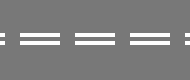 :
:

2) When there are two reversible lanes adjacent on both sides of road marking 1.9.: Examples:
Traffic light signals at railway crossings:
These are two red lights arranged horizontally, or a single flashing white (moon-white) signal, respectively. ,
, 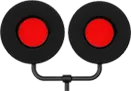 ,
,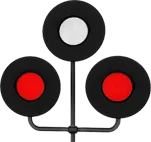 .
.
 – A flashing white (moon-white) signal, or the absence of any signal, permits crossing the railway crossing


 – A red signal (including a flashing one), or two alternately flashing red signals, prohibit movement


Pedestrian crossing traffic light signal:
– To indicate uncontrolled intersections and pedestrian crossings

This is a special device that warns drivers about pedestrians by continuously flashing a yellow light and is installed primarily.
– For regulating traffic on the premises of enterprises and organizations, as well as in places where the roadway is narrowed

Two-section LED traffic lights are installed to inform drivers that entry into a parking area is permitted. They are used to regulate traffic at road, bridge, and tunnel repair sites. They are also used to close streets during events and parades in places where the necessary infrastructure is not available.
Traffic light signal — green «+»:
1) The green «+» — shaped signal indicates that a prohibiting red traffic light signal is currently shown for vehicles coming from the opposite direction.

2)  A switched-off green «+» — shaped signal indicates that vehicles from the opposite direction have a permissive green traffic light signal.

A lit green “+” shows that vehicles coming from the opposite direction (from the other side of the intersection) have a red signal, therefore it is allowed to turn left. Unlike an additional arrow, the “+” does not prohibit a left turn even when it is switched off, which contributes to increasing the throughput capacity of the intersection.
«Tram» traffic light:
The unlit lower lamp of a “tram” traffic light prohibits movement, while the lit one permits it. The upper lamps indicate the directions in which movement is allowed
1) Permitted directions of tram movement under different signals of a single-color traffic light (tram traffic light):
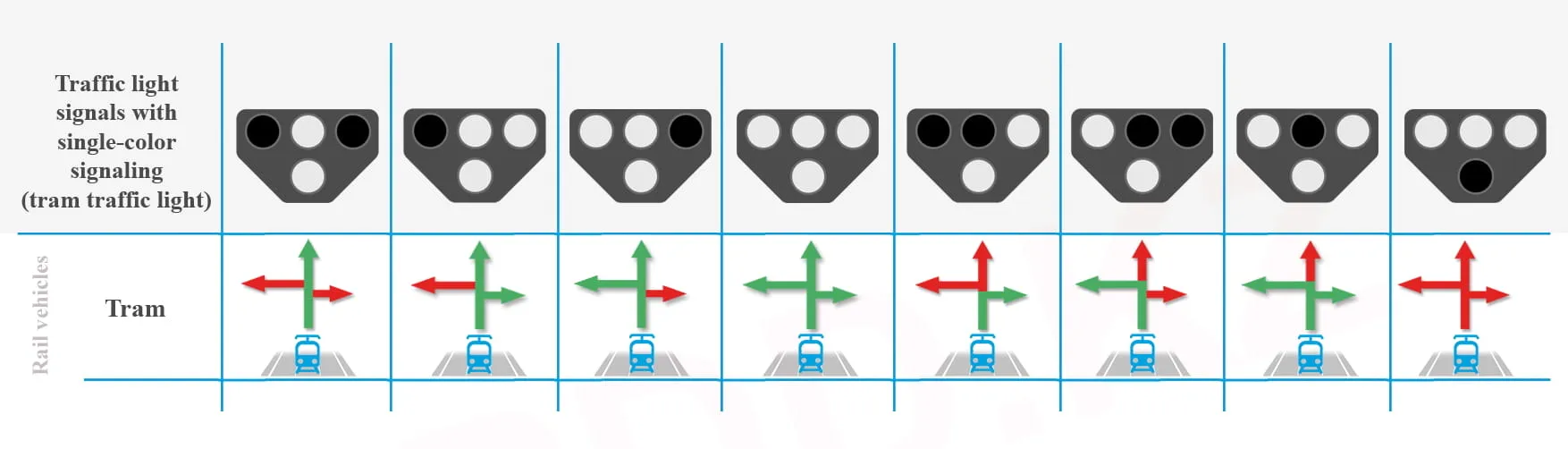 To regulate the movement of trams, as well as other route vehicles traveling along a dedicated lane, single-color traffic lights with four circular signals of white (moon-white) color arranged in the shape of the letter “T” may be used. Movement is permitted only when the lower signal and one or more upper signals are switched on simultaneously
The signals of such a traffic light regulate the movement of trams and other route vehicles. Trams, when they have simultaneous right of movement with non-rail vehicles, have priority.
Remember the traffic light signal colors:
1) Traffic lights use light signals of four colors
 green,
 yellow,
 red,
red,
 white (moon-white).
2) Red and a steady yellow light prohibit movement.
3) A flashing yellow light is used to attract the driver’s attention.
4) The unlit lower white (moon-white) lamp of a “tram” traffic light prohibits movement, while the lit one permits it. The upper lamps indicate the directions in which movement is allowed.
5) If a green arrow silhouette is lit in the additional section, it is allowed to move in the direction indicated by it, regardless of the signal in the main section.
6) If a prohibiting signal is shown in the main section, when moving under a permissive arrow you must give way to vehicles coming from other directions and to pedestrians.