Tire – a part of a vehicle’s wheel that provides traction, reduces noise and vibrations, minimizes the impact of road irregularities, and ensures driving safety.
1. Automotive Tire Sizes (European Standard)
The first and main parameter is the numbers on the sidewall. Example: | |||
| 205 | 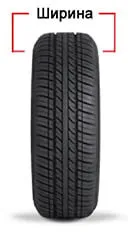 | Section width – indicates the width of the tire, measured in millimeters; | |
| 55 | 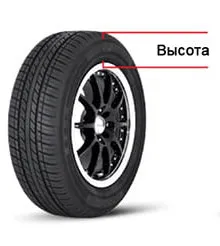 | Aspect ratio (profile height) – the ratio of the tire’s height to its width, expressed as a percentage. To calculate the tire height (the distance between the rim edge and the outer edge of the tread), use the following formula: 205 × 0.55 = 112.75 mm. Increasing the tire’s width and height may prevent the wheel from fitting into the wheel arch or may limit steering clearance; | |
| R16 | 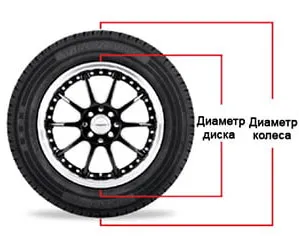 | Rim Diameter R – construction type, indicating a radial carcass design (the tire’s reinforcing cords are arranged radially relative to the center of rotation). 16 – rim diameter, meaning the diameter of the wheel rim in inches (one inch equals 2.54 cm); | |
| 91 |  | Load index – a load-carrying capacity rating that indicates the maximum weight a tire can support; | |
| V |  | Speed index – a speed rating that indicates the maximum speed a tire can safely withstand; | |
American Tire Marking
Russian Tire Marking
2. Automotive Tire Load Indices
(Indicates the permissible load capacity per one tire in kilograms)
| Index | Load | Index | Load | Index | Load | Index | Load |
| 63 | 272 kg | 80 | 450 kg | 97 | 730 kg | 114 | 1180 kg |
| 64 | 280 kg | 81 | 462 kg | 98 | 750 kg | 115 | 1215 kg |
| 65 | 290 kg | 82 | 475 kg | 99 | 775 kg | 116 | 1250 kg |
| 66 | 300 kg | 83 | 487 kg | 100 | 800 kg | 117 | 1285 kg |
| 67 | 307 kg | 84 | 500 kg | 101 | 825 kg | 118 | 1320 kg |
| 68 | 315 kg | 85 | 515 kg | 102 | 850 kg | 119 | 1360 kg |
| 69 | 325 kg | 86 | 530 kg | 103 | 875 kg | 120 | 1400 kg |
| 70 | 335 kg | 87 | 545 kg | 104 | 900 kg | 121 | 1450 kg |
| 71 | 345 kg | 88 | 560 kg | 105 | 925 kg | 122 | 1500 kg |
| 72 | 355 kg | 89 | 580 kg | 106 | 950 kg | 123 | 1550 kg |
| 73 | 365 kg | 90 | 600 kg | 107 | 975 kg | 124 | 1600 kg |
| 74 | 375 kg | 91 | 615 kg | 108 | 1000 kg | 125 | 1650 kg |
| 75 | 387 kg | 92 | 630 kg | 109 | 1030 kg | 126 | 1700 kg |
| 76 | 400 kg | 93 | 650 kg | 110 | 1060 kg | 127 | 1750 kg |
| 77 | 412 kg | 94 | 670 kg | 111 | 1090 kg | 128 | 1800 kg |
| 78 | 425 kg | 95 | 690 kg | 112 | 1120 kg | 129 | 1850 kg |
| 79 | 437 kg | 96 | 710 kg | 113 | 1150 kg | 130 | 1900 kg |
| Subcompact cars, passenger cars | Crossovers, SUVs | ||||||
An index that indicates the maximum load a single tire can carry. An index of 91 means that the tire can support a weight of 615 kg.
3. Automotive Tire Speed Indices
(Indicates the maximum permissible speed at which safe driving is possible)
| Speed index | Permissible speed, km/h | Speed index | Permissible speed, km/h |
| A1 | 5 | K | 110 |
| A2 | 10 | L | 120 |
| A3 | 15 | M | 130 |
| A4 | 20 | N | 140 |
| A5 | 25 | P | 150 |
| A6 | 30 | Q | 160 |
| A7 | 35 | R | 170 |
| A8 | 40 | S | 180 |
| B | 50 | T | 190 |
| C | 60 | U | 200 |
| D | 65 | H | 210 |
| E | 70 | V | 240 |
| F | 80 | W | 270 |
| G | 90 | Y | 300 |
| J | 100 | Z | Over 300 |
An index indicated by the manufacturer, representing the maximum speed for comfortable driving, but not the absolute limit.
4. Colored dots on tire sidewalls and stripes on the tread
- Yellow dots or triangles
 Yellow markers in the form of a small triangle or spot with a diameter of 5–10 millimeters are applied by the manufacturer to the tire’s sidewall at its lightest point, determined at the factory using the balancing method. During installation, this marked spot should be aligned with the “L” symbol on the rim (the light zone of the wheel), or if absent, with the inflation valve (nipple). Following these recommendations allows the assembled wheel to be balanced as evenly as possible, requiring fewer compensating weights during balancing. It is clear that the weight difference between individual zones of the wheel is minimal, so the relevance of the yellow mark diminishes during active tire use, even before the next tire remount.
 - Red dots and triangles
Similarly to the previous mark, the red one indicates the stiffest—and therefore heaviest—area of the tire’s sidewall. Accordingly, it is placed on the side and should be aligned with the “L” on the rim or positioned opposite the valve. Red marks are most often found on tires supplied as original equipment for vehicles. It should be noted that rims from the original equipment set have a marking (white dot) that should be aligned with the red marks.
Another point regarding these markers: when installing wheels, drivers are advised to focus only on the yellow marks, aligning them with the valve, and to ignore the red marks, which are intended for proper tire placement on the rim under factory conditions. - White stamp with a number
A white mark in the form of a circle, triangle, diamond, or square with a number inside, located on the tire’s sidewall, is analogous to the quality control (OTK) mark familiar to people since the Soviet era. Its presence indicates that the product has passed the factory’s final quality inspection and fully meets the stated specifications. In addition, this stamp identifies the specific company employee responsible for the accuracy of the quality control performed on the finished tire. - Colored lines
Colored lines on a tire’s tread are intended to identify tire sizes and models when stacked in racks or pyramids in a warehouse. Tires of a specific size are marked with stripes of unique color, width, and placement, which greatly helps warehouse workers recognize the correct product among many similar ones. Additionally, the colored lines serve as an indicator to determine whether the tire has undergone a break-in period. - White circle or dot
Some tire manufacturers apply white circle or dot markers to products intended for original vehicle equipment. The location of this mark indicates the point of minimal radial force deviation. In other words, it is the most flexible point on the tire’s sidewall. When assembling the wheel, this marker should be aligned with the “L” on the rim or matched with the “top” mark on the wheel.
 Yellow markers in the form of a small triangle or spot with a diameter of 5–10 millimeters are applied by the manufacturer to the tire’s sidewall at its lightest point, determined at the factory using the balancing method. During installation, this marked spot should be aligned with the “L” symbol on the rim (the light zone of the wheel), or if absent, with the inflation valve (nipple). Following these recommendations allows the assembled wheel to be balanced as evenly as possible, requiring fewer compensating weights during balancing. It is clear that the weight difference between individual zones of the wheel is minimal, so the relevance of the yellow mark diminishes during active tire use, even before the next tire remount.
 Similarly to the previous mark, the red one indicates the stiffest—and therefore heaviest—area of the tire’s sidewall. Accordingly, it is placed on the side and should be aligned with the “L” on the rim or positioned opposite the valve. Red marks are most often found on tires supplied as original equipment for vehicles. It should be noted that rims from the original equipment set have a marking (white dot) that should be aligned with the red marks.
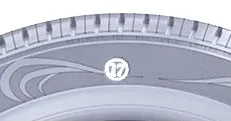 A white mark in the form of a circle, triangle, diamond, or square with a number inside, located on the tire’s sidewall, is analogous to the quality control (OTK) mark familiar to people since the Soviet era. Its presence indicates that the product has passed the factory’s final quality inspection and fully meets the stated specifications. In addition, this stamp identifies the specific company employee responsible for the accuracy of the quality control performed on the finished tire.
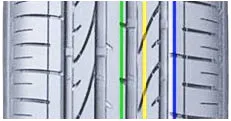 Colored lines on a tire’s tread are intended to identify tire sizes and models when stacked in racks or pyramids in a warehouse. Tires of a specific size are marked with stripes of unique color, width, and placement, which greatly helps warehouse workers recognize the correct product among many similar ones. Additionally, the colored lines serve as an indicator to determine whether the tire has undergone a break-in period.
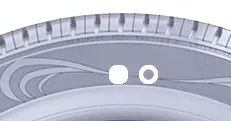 Some tire manufacturers apply white circle or dot markers to products intended for original vehicle equipment. The location of this mark indicates the point of minimal radial force deviation. In other words, it is the most flexible point on the tire’s sidewall. When assembling the wheel, this marker should be aligned with the “L” on the rim or matched with the “top” mark on the wheel.